Auto Conversion for Miners: Turning Altcoin Rewards Into BTC
A multi-coin pool pays you in whichever chain you mined, which is not always the chain you want to hold. Auto conversion lets that reward be turned into another asset inside the same account, so the decision moves from a weekly manual task to a rule you set once. The number to keep in view is simple: at 1 PH/s, one day of BTC-denominated output is about 0.000449 BTC, worth roughly $37.99 on 21 September 2026.
Key takeaways
- ViaBTC supports 20+ coins including BTC, BCH, LTC/DOGE merged mining, KAS, ZEC, HNS, CKB and ETC, so a single account can receive rewards in several assets.
- Auto conversion turns received balances into a chosen asset without leaving the account, removing one withdrawal, one deposit and the waits attached to both.
- Timing, not interface, is the cost: rewards worth $37.99 converted at the 21 September 2026 BTC price of 84,692 give 0.000449 BTC, and a 5% adverse move before conversion gives about 0.000427 BTC instead.
- Mining payouts are listed as zero-fee, and settled balances arrive hourly under PPS+, which is what makes a conversion rule practical rather than theoretical.
Definitions first
Three terms get used interchangeably and should not be. A multi-coin pool lets one account mine several chains, either by switching your machines between them or through merged mining, where a machine secures a parent chain and an auxiliary chain at the same time. A multi-currency wallet holds balances in each of those coins side by side with the mining dashboard. Auto conversion connects the two: a rule that converts incoming balances into the asset you nominate.
Why miners need it comes down to arithmetic. A miner who wants BTC exposure but mines an auxiliary chain receives something else first. Selling that reward on a venue outside the pool costs a transfer and a deposit; holding it means accepting exposure to a second asset's price. Conversion inside the account shortens that path to a single internal operation, and the balance arrives in the wallet the mining account already uses.[1]
The trade-off nobody prices
The priced trade-off between payment methods is the fee: PPS+ lists 4% on the PPS-settled block-reward component and 2% on the transaction-fee component, while PPLNS merges both and lists 2%, leaving reward variance with the miner.[2] That much is visible on a fee page.
The unpriced one is conversion timing. Every hour a reward sits in a coin you do not intend to hold, you carry that coin's price risk against your target asset. For a miner with 1 PH/s, a day of output is worth about $37.99; a 5% move against you before conversion silently removes about $1.90 of value from work that already happened. Repeated across a month of manual conversions, that is a cost with no line item.
Delivery lag matters for the same reason. PPLNS distributions follow blocks after six confirmations, measured over the last five difficulty rounds, so under that method rewards can arrive in larger, less predictable chunks than the hourly cadence of PPS+. A conversion rule set in advance treats both the same way; a manual routine tends to convert when someone remembers to log in.
| Reward asset | Price used (USD) | Amount equal in value to one day of 1 PH/s BTC output | Thirty-day equivalent |
|---|---|---|---|
| BTC | 84,692 | 0.000449 BTC | 0.013458 BTC |
| LTC | 59.32 | 0.6405 LTC | 19.21 LTC |
| BCH | 261.48 | 0.1453 BCH | 4.36 BCH |
| KAS | 0.04130647 | 919.79 KAS | 27,593 KAS |
The point of the table is not that one coin is better. It is that the quantities look nothing alike — 0.000449 BTC against 27,593 KAS for the same dollar figure — which is exactly why a manual conversion habit is fragile. Nobody eyeballs a 27,593-unit balance accurately, and nobody wants to run the multiplication each time a payout lands.
Example with two setups
Setup A runs 1 PH/s on BTC with PPS+ and keeps everything in BTC. Daily settlement is 0.000449 BTC, worth $37.99, arriving hourly in increments of about 0.0000187 BTC. Over 48 hours the account holds roughly 0.000898 BTC, and there is nothing further to decide.
Setup B runs the same 1 PH/s but on an auxiliary chain and converts rewards to BTC once every three days. Rewards arrive as an altcoin balance, and the conversion rate is whatever the market gives on day three. If the altcoin fell 5% against BTC during those three days, the same work buys about 0.001280 BTC instead of 0.001347 BTC over 72 hours — a shortfall near $5.70 on one conversion cycle. Divide that by three days and it is roughly $1.90 a day of leaked value, comparable to a meaningful share of a fee difference.
Both setups also have a third option that does not require selling at all: borrowing against held collateral. The workflow behind collateral-pledged loans is deliberately mechanical — add collateral, request a loan, receive the disbursement, repay, then redeem the collateral — and it lets a miner cover an electricity invoice without liquidating the coins that are meant to be held.[3] For an operation with a fixed monthly power bill, that is often cheaper than selling rewards into a weak week.
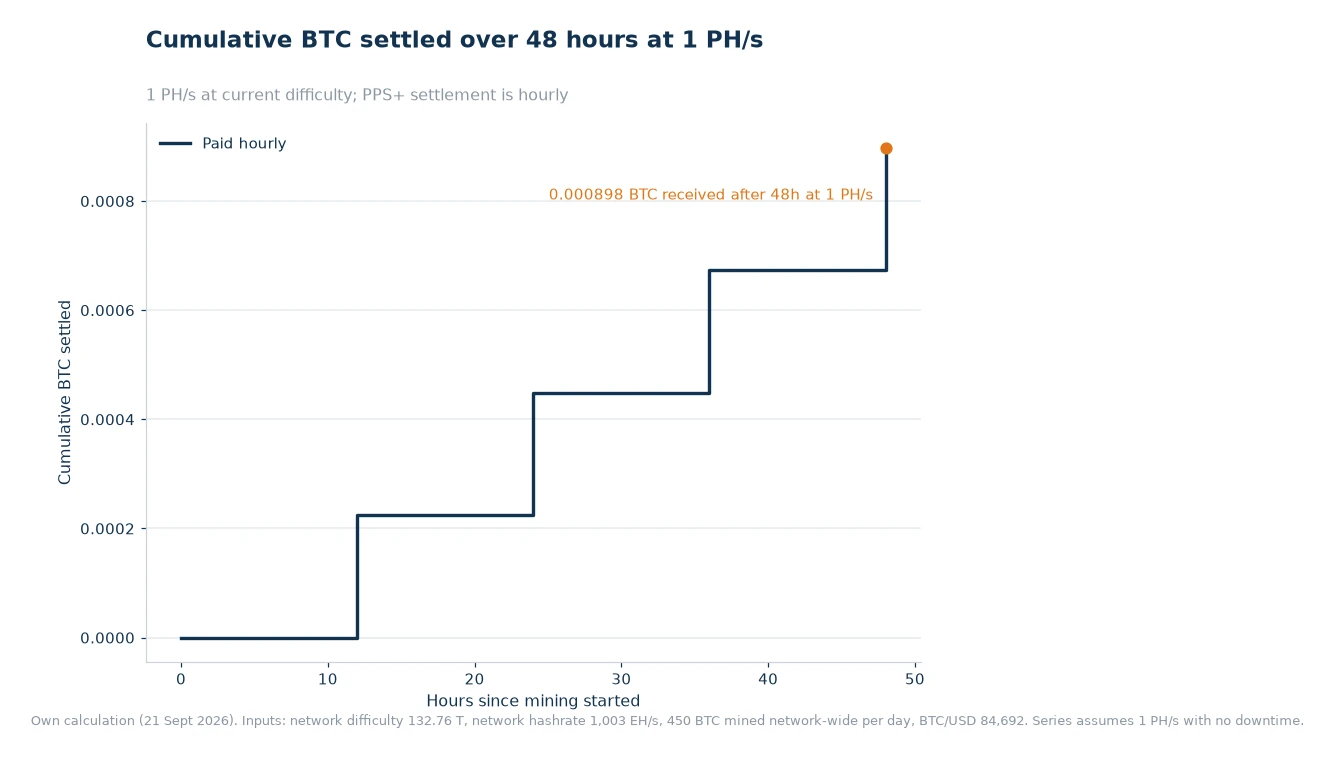
Notice what the chart implies for a rule. There are 48 opportunities to convert in this window, each small. A rule that converts on receipt averages the rate over the whole two days; a manual conversion happens once, at whatever the rate is that afternoon. Averaging is not a strategy for beating the market — it is a way of no longer depending on the moment someone remembers to check the balance.
Practical next steps
- Decide the target asset before touching settings. Write down whether mining rewards should accumulate in BTC, be held in the mined coin, or be converted for a specific obligation such as a power bill.
- Match the conversion cadence to settlement. Hourly settlement under PPS+ pairs naturally with a frequent rule; if you are on PPLNS, remember rewards land after six confirmations and are measured over the last five difficulty rounds.
- Keep the payout rail in the same account. Mining payouts are listed as zero-fee, and an in-account conversion avoids an outbound transfer plus a re-deposit. That is the main structural advantage of using the ViaBTC Crypto Wallet alongside the pool rather than a separate service.
- Check the coin mix you can actually mine. With 20+ supported coins, the right answer changes with difficulty: when one chain gets crowded, a pool that supports switching and merged mining keeps the hardware useful. zero-fee mining payouts and in-account conversion make those switches operationally quiet.
- Review once a month. Compare the BTC you received against the BTC your hashrate should have produced at that month's average difficulty, and treat any persistent gap as a settings problem before assuming it is a market one.
Frequently asked questions
Does the payout method change my average income?
It changes the variance and the fee, not the underlying expected value: your share of network hashrate still sets the ceiling.
How often should a miner check pool statistics?
Weekly is enough for cash flow, daily if you are reconciling worker uptime or chasing a hashrate fault.
Is converting altcoin rewards the same as selling them?
No. A conversion changes which asset you hold inside the account; a sale moves value out to cash through a counterparty. Conversion addresses the timing problem, while selling addresses a liquidity need — and collateral-pledged borrowing is the third option when the need is temporary.
Can I mine more than one coin at a time?
Yes. Merged mining lets a machine secure a parent chain and an auxiliary chain together, and a multi-coin pool lets you switch a machine between supported chains without physically moving it.
Set the rule, then stop watching it
Pick the asset you want to hold, set a conversion cadence that matches how often your pool settles, and leave the payouts to land. Review the month's realised BTC against what your hashrate and the month's difficulty imply, and only change the rule when that comparison shows a gap. The decision that matters is made once; everything after that is arithmetic you no longer have to do by hand.
Data and sources: ViaBTC wallet and payout documentation[1], ViaBTC fee schedule[2] and collateral-pledged loan workflow[3]. Prices (BTC 84,692 / LTC 59.32 / BCH 261.48 / KAS 0.04130647), network difficulty of 132.76 T and a network hashrate of 1,003 EH/s were read from public chain data and market feeds on 21 September 2026; conversion-equivalence and cumulative BTC figures are our own calculation from those inputs. Prices and difficulty change continuously, and nothing here is investment advice or a projection of profit.