From 1.5 mm² to 240 mm²: The Range Behind One Order
One dimension table published by KUKA CABLE runs from 1.5 mm² to 240 mm², so a rooftop string and a combiner feeder can be quoted from the same document. The two ends weigh 34 g/m and 2,350 g/m, a spread that decides drums, lifting gear and roof loads long before the electrical check begins.
Key takeaways
- Fifteen nominal cross-sections are listed, from 1.5 mm² up to 240 mm², with 4 mm², 6 mm² and 10 mm² named as the commonly used specifications.
- The conductor steps from 0.25 mm strands to 0.29 mm strands at 4 mm², then to 0.39 mm strands above 70 mm².
- Nominal weight per metre rises from 34 g/m to 2,350 g/m across the table.
- No minimum order quantity, price or lead time is published per size, so those terms must be requested directly.
Why fifteen sizes sit in one table
A photovoltaic plant uses different conductors in different places, and each position has its own flexibility and current requirement. Module strings on a roof need a cable that follows a mounting rail, bends around a ridge and survives being walked on, while array feeders and inverter connections carry more current and tolerate a stiffer, heavier construction. The manufacturer treats 4 mm², 6 mm² and 10 mm² as the commonly used specifications, which covers most residential and commercial rooftop work. Ground-mounted and utility-scale plants move up through 16 mm², 25 mm², 35 mm², 50 mm², 70 mm², 95 mm², 120 mm², 150 mm², 185 mm² and 240 mm² when array blocks sit far from the inverter building. The same family also includes single-core and twin-core versions, so a twin-core 6 mm² length can replace two parallel single-core runs along one rail. Anyone planning a mixed project can see the whole PV cable range on one page and compare the sizes side by side.
Where the conductor construction changes
The published table is not a scaled series; the strand diameter moves in steps. Sizes 1.5 mm² and 2.5 mm² are built from 39 and 49 strands of 0.25 mm. From 4 mm² up to 70 mm² the strand measures 0.29 mm and the count rises with the area: 56 strands at 4 mm², 84 at 6 mm², 142 at 10 mm², 238 at 16 mm², 375 at 25 mm², 520 at 35 mm², 760 at 50 mm² and 1,085 at 70 mm². Above 70 mm² the strand steps to 0.39 mm so the finished conductor stays workable: 760 strands at 95 mm², 950 at 120 mm², 1,216 at 150 mm², 1,460 at 185 mm² and 1,968 at 240 mm². The 1500 V solar cable page describes the conductor as tinned copper, class 5 flexible according to IEC 60228, with electron-beam cross-linked XLPO insulation and sheath in low-smoke halogen-free compound. Strand count, not area alone, is what makes a 240 mm² conductor bendable by hand.
Diameter and weight, size by size
Nominal overall diameter grows more slowly than mass. The published values run 4.6 mm at 1.5 mm², 5.0 mm at 2.5 mm², 5.5 mm at 4 mm², 6.0 mm at 6 mm², 7.5 mm at 10 mm², 11.0 mm at 25 mm², 12.3 mm at 35 mm², 18.0 mm at 95 mm² and 27.0 mm at 240 mm². Weight per metre for a selection of those sizes is 59 g/m at 4 mm², 78 g/m at 6 mm², 130 g/m at 10 mm², 390 g/m at 35 mm², 960 g/m at 95 mm² and 2,350 g/m at 240 mm². Insulation thickness is given as 0.7 mm with a 0.8 mm sheath on the 1.5 mm² to 10 mm² sizes, and as 0.9 mm to 1.7 mm insulation with a 0.8 mm to 1.7 mm sheath above that. An installer planning trays or rails needs both columns, because a 27 mm solar cable needs a wider bend and a heavier support than its current rating alone suggests.
| Cross-section | Conductor | Overall diameter | Nominal weight | Load for 100 m (author's calculation) |
|---|---|---|---|---|
| 1.5 mm² | 39 × 0.25 mm | 4.6 mm | 34 g/m | 3.4 kg |
| 4 mm² | 56 × 0.29 mm | 5.5 mm | 59 g/m | 5.9 kg |
| 10 mm² | 142 × 0.29 mm | 7.5 mm | 130 g/m | 13.0 kg |
| 35 mm² | 520 × 0.29 mm | 12.3 mm | 390 g/m | 39.0 kg |
| 95 mm² | 760 × 0.39 mm | 18.0 mm | 960 g/m | 96.0 kg |
| 240 mm² | 1,968 × 0.39 mm | 27.0 mm | 2,350 g/m | 235.0 kg |
Life and standards behind the range
The site expects the family to stay in service for a long period, describing a solar cable life of 25 years or more, with one product page giving 30 years for its own model. Product names include H1Z2Z2-K, PV1-F and UL 4703 wire, and the 6 mm² example carries a rated voltage of DC 1.8/1.8 kV, a spark test at 10 kV during production and a test voltage of 6.5 kV AC for five minutes on the finished cable. Its stated ambient range is −40 °C to +90 °C, with short-circuit limits of +120 °C for 20,000 hours and +250 °C for five seconds, and a bending radius of four times the outer diameter. Certificate names on the site include TUV, IEC, CPR, CE, SAA and UL, and the standards quoted for the PV product line are TUV 2PfG 1169/08.2007, EN 50618:2014 and IEC 62930. Those values are the ones to check on a datasheet before accepting a quotation, whichever size in the range is being bought.
What the milestone dates show
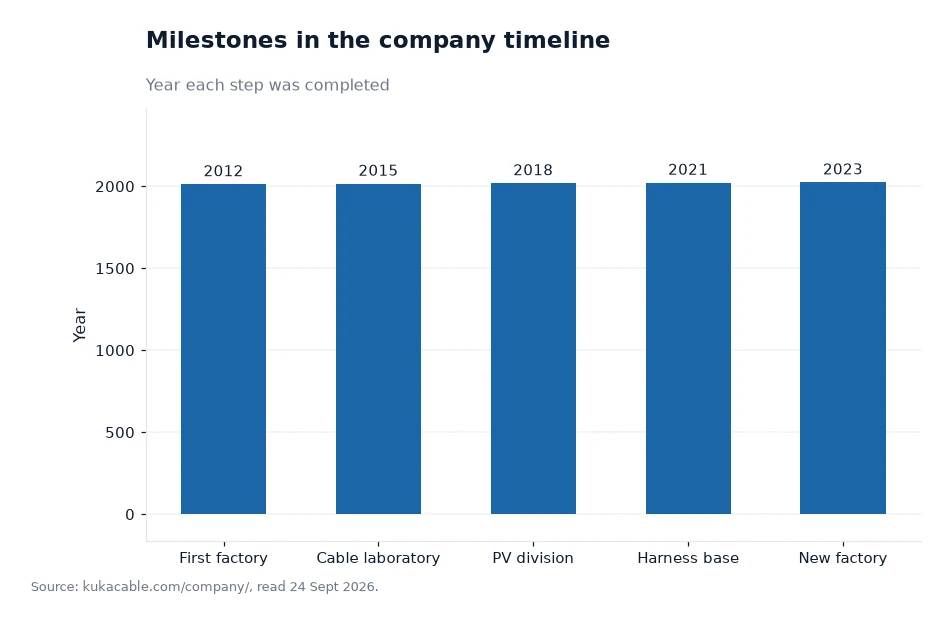
The company timeline published on kukacable.com/company/ explains how one manufacturer came to hold a table this wide. Charted as years, the five steps are 2012 for the first factory, 2015 for the speciality cable laboratory, 2018 for the independent PV division, 2021 for the wire harness processing base and 2023 for the new factory. The laboratory date carries the most weight for a fifteen-size range, because every cross-section needs its own dimensional and electrical checks; the site dates that laboratory to December 2015 and describes it as an ISO/IEC 17025 facility. The PV division became independent in August 2018 and covers DC cables, AC cables, inverter plug wires, connectors and wiring harnesses. The company also states that its facility covers more than 7,000 m² and that products and services reach customers in more than 120 countries.
Worked example: one drum at each end
Suppose an enquiry asks for 1,000 m of the smallest size and 1,000 m of the largest. At 34 g/m, the 1.5 mm² length works out at 34 kg (author's calculation: 34 × 1,000 ÷ 1,000). At 2,350 g/m, the 240 mm² length works out at 2,350 kg, about 69 times the first figure. Drum lengths are not published on the site, so 1,000 m is an assumption used only to keep the comparison simple; the mass per metre is the published value from the dimension table. The practical consequence is that two "one drum" lines on the same order can differ by a factor of roughly seventy in weight, so lifting equipment, pallet type and freight class have to be checked for the heavy end and not assumed from the light end.
Frequently asked questions
Does the table cover sizes below 4 mm²?
Yes. It starts at 1.5 mm² and 2.5 mm², both built from 0.25 mm strands, with 4.6 mm and 5.0 mm nominal overall diameters and weights of 34 g/m and 45 g/m. From 4 mm² the conductor switches to 0.29 mm strands and the series continues to 240 mm², where 1,968 strands of 0.39 mm give a 27.0 mm diameter and 2,350 g/m.
Is a minimum order or price published per size?
No. The site publishes dimensions, weights, test data and certificate names, but no minimum order quantity, unit price or delivery time for any cross-section. Buyers should request a written quotation that lists each size separately, together with its conductor construction, nominal diameter and weight per metre.
What a buyer should ask for
Ask the supplier to confirm the conductor construction and the standard behind it, then match the answer against the published table for the exact size in the order. Request the data sheet for the model in question, whether that is H1Z2Z2-K, PV1-F or UL 4703 wire, and check the stated ambient range of −40 °C to +90 °C and the bending radius of four times the outer diameter. Compare the claimed figures with the published test list, which names water resistance, UV accelerated weathering, abrasion, cold bending, tensile testing after ageing and dimensional checks. If a project mixes sizes, ask for the weight per metre of each one, because that single figure decides handling and freight. The site leaves commercial terms open, so the quotation is the only place they will appear.
Cross-section data from 1.5 mm² up to 240 mm² and the timeline years are the manufacturer's own, published on kukacable.com and read afresh 24 Sept 2026[1].