What a Private Label Skincare Quote Leaves Out: MOQ, Moulds and Testing
A unit price is the smallest part of a skincare quotation and the easiest to compare. The expensive lines sit underneath it: the order quantity that decides your cash exposure, the tooling that has to be paid before the first run, and the testing window that dictates whether the product can launch on your date at all. Read those three before you compare a single price.

Key takeaways
- First orders can start at 500 units, while the usual band for skincare OEM work sits between 1,000 and 5,000 units.
- Tooling and packaging lead time are named by suppliers as one of three schedule risks, alongside ingredient sourcing and testing.
- Stability and compatibility reports take three to six months, and a sensitive-skin claim adds patch test results on top.
- Fixed items do not scale with quantity, so the same report covers 500 units or 5,000 — the per-unit share falls tenfold.
The line that decides your cash exposure
The order minimum is not a supplier preference; it is the smallest batch the plant can run without disruption. Published bands for skincare sit at 1,000–5,000 units per product, with some factories opening a 500-unit route for first orders. Your exposure is that quantity multiplied by the price you agreed, payable before you have a single sale.
Ask the question the other way round: what is the smallest order you accepted last quarter, and what did it cost the buyer to amend afterwards? Suppliers who answer that plainly are easier to plan with than those who quote only in units.
Tooling and packaging: the line nobody itemises
Moulds, decoration and cartons are the second omission. A stock jar needs no tooling; a custom jar needs a mould, a lead time and a minimum run of its own, often through a different supplier. That is why packaging appears in a factory's own list of schedule risks rather than in the price table.
Ask for the packaging lead time separately from the product lead time, then check whether the two can run in parallel. If the pack is ordered after the formula is approved, its lead time is added to your launch date rather than absorbed into the project.
Testing: the window that sets the launch date
Testing is the quietest line item and the one most likely to move a launch. Stability and compatibility reports take three to six months. Sensitive-skin claims need patch test results as well, and those are planned separately from stability work.
| Quote line | Published figure | Why it is easy to miss |
|---|---|---|
| Order minimum | 1,000–5,000 units; 500 for start-ups | Quoted as a band, not as your batch |
| Stability and compatibility | 3–6 months | Absorbed into "lead time" without a date |
| New development | 3–6 months, research to production | Only visible when the base is new |
| Packaging lead time | Named as a schedule risk | Usually quoted by a third party |
Documents and freight: the lines that appear last
Two more items belong on the comparison sheet. The first is the document set you will need at the border: a specification sheet that matches the approved sample, stability reports with issue dates, and certificate copies whose scope covers the product. Ask for one example of each before any deposit is paid.
The second is freight and packing. Pallet dimensions, carton counts and the shipping terms decide whether your landed cost matches the quote you compared, and they are quoted by people other than the formulator. A quote that lists products but not packing is comparing half of a delivered cost.
Ask two questions that make the answer concrete: how many units fit on a pallet, and what the carton weight limit is for the market you ship into. A 150 ml pack and a 15 ml jar can carry identical product lines and still produce pallet plans that differ by a factor of several, so the answer belongs on the same page as the unit price.
Neither item is a reason to distrust a supplier. They are simply the lines most often left for the second email, which is exactly where they become expensive.
Worked example: how fixed effort scales with order size
Take the published start-up quantity of 500 units as one multiple. The low end of the typical band, 1,000 units, is 1,000 ÷ 500 = 2 multiples, and the high end, 5,000 units, is 5,000 ÷ 500 = 10 multiples. That part is simple multiplication.
The interesting part is the fixed work. A stability report, a packaging approval and a sample round each happen once, whichever multiple you choose. Expressed per unit, one unit of fixed effort divided by 500 units is 1 ÷ 500 = 0.0020 per unit; the same effort divided by 5,000 units is 1 ÷ 5,000 = 0.0002 per unit. A tenfold larger order spreads that fixed work over ten times as many units. It does not follow that the unit price falls by the same factor, because material and filling costs scale directly, but it explains why a 500-unit quote can look high per unit and still be the cheaper way to test a market.
Reading the order-size chart
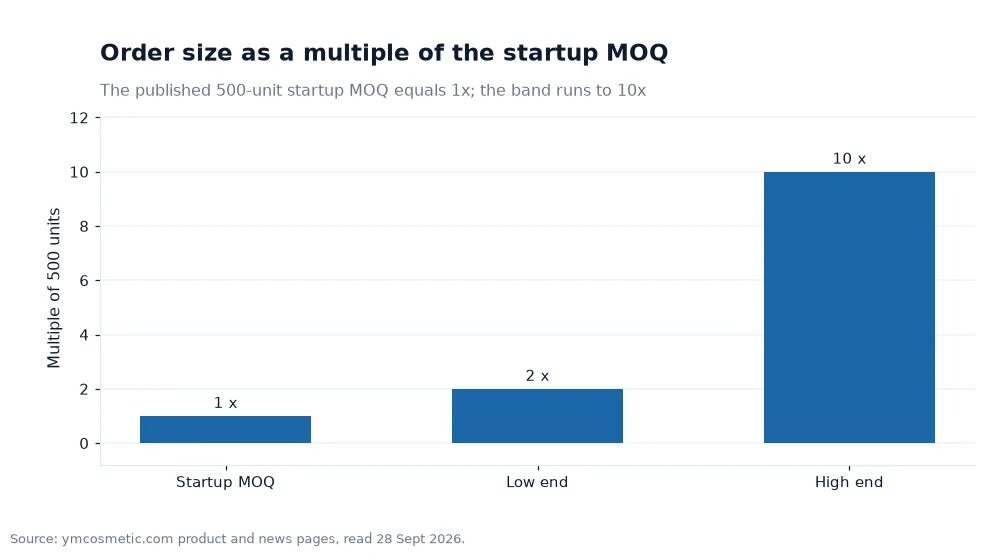
Presented this way, the band stops looking like a range and starts looking like a decision. The two upper bars are the ones most quotes assume; the lower bar is the one you may actually want for a first product. Whichever you pick, the fixed lines stay the same, which is the argument for choosing the quantity deliberately rather than accepting the one on the form.
Frequently asked questions
Why does a bigger order not lower the unit price by the same factor?
Because only part of the work is fixed. Reports, approvals and sampling happen once, so their share per unit falls as quantity rises. Materials, filling and packing scale with every unit, and those make up the larger part of the cost.
Should tooling be paid before the formula is approved?
You can start a pack that uses a stock component without waiting, since it needs no tooling. A custom mould is better ordered once the formula and the fill volume are settled, because a change in volume can invalidate the tooling design.
What belongs in a quotation request to make quotes comparable?
Product type, pack size, target quantity, route, intended claim and required documents. Ask every supplier to state the order minimum, the testing window and the packaging lead time separately, in writing, on one page.
Comparing quotes without guessing
Put the three omitted lines on the same sheet: order quantity, tooling and packaging lead time, and the testing window. A quote that names all three can be scheduled; one that names only a unit price cannot. If you are still building the shortlist, the published comparison of private label skincare manufacturers China applies the same filters to ten named companies, and Yunmei's OEM/ODM manufacturing services page states its own order bands, sample policy and inspection position in one place. Where the first product is colour rather than skincare, the lipstick line page shows which lines change.
The order bands, testing windows and schedule-risk factors in this article were read at ymcosmetic.com, the manufacturer's website, on 28 Sept 2026. Mine is the multiple and per-unit arithmetic in the worked example, applied to those published quantities.[1].